
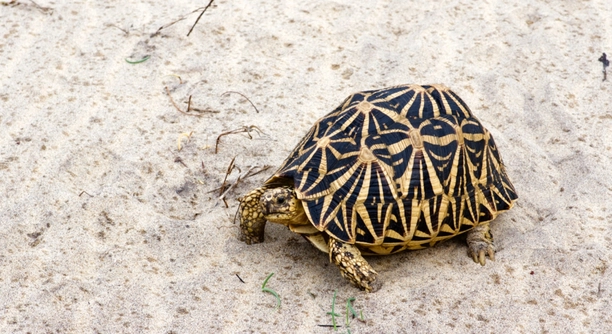
Determining the sex of your Indian Star Tortoise can be tricky, but understanding it is important for proper care. Male and female tortoises have subtle differences that can help identify them.
The most reliable way to tell the difference between a male and female Indian Star Tortoise is by observing their physical traits. Males tend to have a concave plastron and longer tails, while females are generally larger and have flat plastrons.
Knowing these differences helps in providing the best care for your tortoise. There are several other methods to help confirm its sex. Keep reading to explore all the ways to identify your tortoise’s gender.
Observing the Shape of the Plastron
The plastron, the bottom part of a tortoise’s shell, plays an important role in identifying its sex. Males typically have a concave, or inwardly curved, plastron. This shape helps them mount females during mating. On the other hand, females have a flat plastron. The flat shape allows for more space to carry eggs. To observe this difference, gently lift your tortoise and look at the bottom of its shell.
Both males and females will have a strong, protective shell, but the plastron’s shape is one of the most noticeable and reliable indicators. The concave plastron of the male provides a subtle, yet effective, visual clue to differentiate it from the flat female plastron. This feature is one of the easiest to check, especially in adult tortoises.
If your tortoise is younger, this method might not be as effective, since the plastron hasn’t fully developed yet. As your tortoise matures, the difference will become more visible and easier to spot.
Checking the Tail Length
Another key feature to observe is the length of the tail. Males typically have longer and thicker tails compared to females. This difference is a result of the tail’s role in reproduction. Longer tails allow males to more effectively mate with females.
The tail’s length is an obvious indicator as your tortoise ages. When compared side by side, the male’s tail will be noticeably longer and extend past the edge of the shell. Females have shorter tails that are less noticeable and don’t extend far beyond their shell.
Observing the Size and Shape of the Carapace
The carapace, or the top shell, also gives clues about the tortoise’s sex. Males are generally smaller and have a more domed carapace, while females are larger with a flatter shell. This size difference helps females carry eggs and provides extra space.
The dome shape of the male’s carapace is useful during mating, making it easier for them to approach females. As males are usually smaller, they are more agile. Females, with their flatter and broader carapace, need this extra space to accommodate their reproductive system. This is especially noticeable in adults.
While this method can be helpful, it might not be as obvious in younger tortoises. With age, the size and shape difference becomes more apparent, helping confirm the tortoise’s sex.
Examining the Plastron Notch
The plastron notch is a small, subtle difference seen in males. They tend to have a slight notch at the end of the plastron, near the tail. This feature helps them align better during mating. It’s usually not found in females, whose plastrons have a smooth edge.
The notch in the male’s plastron is another indicator that becomes clearer as they grow. In younger tortoises, this feature may be harder to spot, but it’s much easier to identify in adults. This subtle notch doesn’t serve a major role in daily life but is helpful when trying to determine sex.
When comparing the plastron edges, pay close attention to any indentation near the tail area. A slight inward curve is a sign of a male. For a female, this area will appear smooth and even.
Looking at the Vent Location
The location of the vent can also help in determining the sex of your tortoise. Males typically have their vent located further from the body, closer to the tail. Females have their vent positioned closer to the edge of the plastron.
As males grow, the vent moves further from the shell, which is a noticeable feature. This difference becomes especially clear when comparing an adult male and female. It’s another visual clue to help with identification. However, it might be difficult to spot in younger tortoises.
Observing Behavior
Behavioral differences can sometimes indicate the sex of a tortoise. Males tend to be more active and often show more aggression, especially toward other males. They are also more likely to display mating behavior, such as trying to mount other tortoises.
Females are generally calmer and more passive. During breeding season, their behavior might change slightly, but it’s usually not as aggressive or active as that of the males. These behavioral patterns can help you identify which sex your tortoise is, especially when paired with physical traits.
Checking for a Tail Hook
Males often have a slight hook at the end of their tail, which is useful for mating. This hook is not visible in females, whose tails are more straight and uniform. The hook helps males grip the female during copulation.
Not all males will have a prominent hook, but it’s a small, noticeable difference that can be found in some tortoises. When inspecting the tail, look for a curve or bend at the very tip. This feature becomes more apparent in adult males.
FAQ
How can I tell if my Indian Star Tortoise is male or female at a young age?
At a young age, it can be more challenging to determine the sex of your Indian Star Tortoise. Features like the plastron shape and tail length are not fully developed yet, making it difficult to use these traits for identification. However, even in younger tortoises, males tend to be slightly smaller, with a more domed shell compared to females. With time, as your tortoise matures, these physical features will become more apparent.
Do all male tortoises have a concave plastron?
While most male tortoises have a concave plastron, not all of them will show this trait clearly, especially when they are young. The concave shape helps males during mating, but it becomes more noticeable as the tortoise ages. In some species, the difference may be subtle or develop later in life.
What if my tortoise doesn’t show clear gender traits?
If your tortoise doesn’t show obvious traits, it might still be too young to display distinct physical differences. As tortoises grow, their physical features will become clearer. If you’re unsure, consider consulting a veterinarian who specializes in reptiles, as they may be able to provide an accurate determination.
Can the behavior of my tortoise help determine its sex?
Yes, behavior can offer clues, though it’s not always a definitive method. Male tortoises tend to be more active, especially during breeding season. They may show aggressive behavior toward other males or attempt to mount them. Females, on the other hand, are generally calmer and less active in comparison.
Does the size of the tortoise always indicate its sex?
Typically, females are larger than males, but size differences may not be immediately noticeable in younger tortoises. As tortoises grow, the female’s larger size becomes more apparent. The size difference is primarily due to the need for more space to carry eggs, which is necessary for the reproductive process.
Can I tell the sex of my Indian Star Tortoise by its tail?
Yes, males usually have longer, thicker tails, which are a useful sign in identifying sex. The tail of a male extends farther beyond the shell, while females have shorter tails that do not protrude as much. The tail length is particularly noticeable in adult tortoises, so it may be harder to tell in younger ones.
Are there any differences in the carapace shape between males and females?
Yes, male Indian Star Tortoises tend to have a more domed, curved carapace, while females have a flatter, broader carapace. The shape of the shell helps males during mating, as it makes it easier for them to mount the female. The flatter shell of females accommodates egg production and provides more space for reproductive organs.
What role does the plastron notch play in determining sex?
The plastron notch is often found in males and is a small indentation near the tail. This notch helps males position themselves during mating. Females do not have this notch, and their plastrons are typically smooth and flat. While this trait is subtle, it becomes more visible as the tortoise matures.
Can I use color to identify my Indian Star Tortoise’s sex?
Color alone is not a reliable way to determine the sex of an Indian Star Tortoise. Both males and females have similar coloring, typically a dark shell with bright yellow patterns. While some color variations may exist, these are not consistent indicators of sex.
Should I rely only on physical traits to determine sex?
While physical traits are the most common way to identify the sex of your tortoise, behavioral differences can help. Males are often more aggressive and active, especially around breeding season, while females are usually calmer. However, relying solely on physical traits such as the plastron shape, tail length, and carapace dome is often the most accurate method.
Do tortoises change sex as they age?
No, tortoises do not change sex as they age. The physical differences between males and females are present from a young age and become more pronounced as they mature. If you are unsure about your tortoise’s sex, it may simply be that it is still too young to show clear traits.
Can diet or environment influence the sex of my tortoise?
Diet and environment do not affect the sex of your tortoise. The sex is determined genetically, and there is no evidence to suggest that external factors like diet or habitat can influence this. However, providing a healthy diet and environment will ensure your tortoise grows properly, which can help make physical traits more apparent as it matures.
Determining the sex of your Indian Star Tortoise might not be easy at first, but with careful observation, you can identify the key physical traits that make males and females different. Features like the shape of the plastron, the size of the carapace, and the length of the tail provide reliable clues. Males often have a concave plastron and longer, thicker tails, while females tend to have a flat plastron and shorter tails. These differences become more noticeable as the tortoise matures, making it easier to tell their sex over time.
While these physical traits are the most reliable ways to tell, there are also behavioral differences that can give you more insight. Males are typically more active and show signs of aggression, especially when interacting with other males. During breeding season, you might notice the males trying to mount females or even engaging in mating behaviors. Females, on the other hand, are generally calmer and less likely to display the same level of aggression. These behavioral cues can help you confirm your tortoise’s sex, but they are not always as obvious as the physical traits.
Ultimately, it’s important to remember that identifying the sex of your Indian Star Tortoise may take some time, especially in younger tortoises where the differences are not as clear. As they grow, you’ll be able to observe the changes and make a more accurate determination. If you ever find yourself uncertain, you can always seek guidance from a vet who specializes in reptiles. Whether you’re breeding your tortoises or simply wanting to learn more about their care, understanding their sex is just one more step toward providing them with the best environment and attention.

Hello,
If you enjoy the content that we create, please consider saying a "Thank You!" by leaving a tip.
Every little bit helps us continue crafting quality advice that supports the health, happiness, and well-being of pets around the world, for pets of all shapes, sizes, and species.
We really appreciate the kindness and support that you show us!